12th March 2026
Welcome to my March blog. As we approach April and the launch of the new Norfolk and Suffolk Integrated Care Board, it feels like a natural moment to reflect on the partnerships and progress that have shaped our work across our systems in recent years.
At the beginning of the month I attended the ‘Learning and Legacy’ event for the Suffolk and North East Essex Integrated Care System at Colchester Rugby Club. The event brought together colleagues from across health and social care to reflect on the achievements of the past decade, with speakers sharing their perspectives and learning. It was a fitting opportunity to celebrate the progress made across the system, wish the new Essex system well for the future, and look ahead to the launch of Norfolk and Suffolk in April.
What struck me most was the shared thread of values running through all the contributions. Speakers spoke about the importance of valuing people and partnerships, showing courage and compassion, and being clear about our purpose — particularly when it comes to tackling health inequalities. In my experience, setting strong values and then role modelling them consistently is the first step towards improving health outcomes.
One moment that particularly stood out was when Lee Heley from Tendring District Council spoke about the improvement in the Health Index in Tendring. This represents a significant achievement for partners across the area and demonstrates what can be achieved through genuine collaboration.
As we move forward with Norfolk and Suffolk, I am determined that we take the best learning from both Norfolk and Waveney and Suffolk and north east Essex. By bringing together our strengths and continuing to innovate, we have a real opportunity to improve health outcomes and build a legacy we can be proud of for the communities we serve. I am confident we have the talent across our system to do just that. If you would like to read the full Learning and Legacy report, please click here.
This month also marks six years since the first COVID-19 lockdown — a period that challenged every part of our health and care system. While it was an incredibly difficult time, it accelerated new ways of working, strengthened partnerships and pushed us to innovate in how we support people in their homes and communities.
Many of those changes continue to shape our work today. Below are just some recent highlights from across the system, reflecting the three key shifts we are making together — from hospital to community, from analogue to digital, and towards a stronger focus on prevention.

From Hospital to Community
Providing more care closer to home continues to be a major priority.
It was fantastic to recently visit the Unscheduled Care Coordination Hub in Norwich and see first-hand the impact it is having. The hub reviews 999 calls and helps coordinate alternatives to ambulance dispatch where appropriate, enabling patients to receive care in their own homes while freeing up ambulance capacity to respond to other emergencies. Since launching in the Norfolk and Waveney sector in September 2023, the hub has diverted 62% of calls from the ambulance service — avoiding unnecessary ambulance responses while improving patient outcomes and system efficiency. It’s a great example of what can be achieved when teams work together across ambulance services, NHS 111, GP Out of Hours, community teams and hospitals to ensure patients receive the right care, in the right place, at the right time.
In King’s Lynn, the Queen Elizabeth Hospital’s Maple Midwifery Hub has moved to the new King’s Lynn Health Hub on Cambridge Road. Previously based at the St Augustine’s Centre, the team now delivers antenatal and postnatal clinics from this modern, digitally enabled facility opened in 2025. The hub brings multiple services together under one roof and provides dedicated clinic rooms and office space for the Maple and Poplar community teams, creating a welcoming setting for local families.
Partnership working is also strengthening community care. Norfolk Community Health and Care and Norfolk County Council have renewed their long-standing commissioning partnership through a Section 75 agreement, sharing budgets and leadership to support prevention, integrated community services and improved intermediate and unplanned care. This closer collaboration is already helping improve access to reablement, strengthen 24-hour response services and reduce duplication.
Community support is also expanding for people affected by cancer. In Bury St Edmunds, a new monthly drop-in cancer support group has launched at Newbury Community Centre through a partnership between the Macmillan Information Centre at West Suffolk NHS Foundation Trust and Cancer Support Suffolk. The group provides a welcoming space for people affected by cancer — including relatives and partners — to share experiences, access information and connect with others.
Meanwhile in Stowmarket, a gardening project at Stow Lodge is helping people rebuild strength and confidence after falls or strokes. Led by the Stowmarket Integrated Neighbourhood Team and delivered with East Suffolk and North Essex NHS Foundation Trust and Suffolk County Council, the initiative combines gentle physical activity with social connection. For many participants it has become more than therapy — offering purpose, confidence and community.
From Analogue to Digital
Technology is increasingly helping us improve services and use clinical time more effectively.
Across the East of England, smarter use of digital tools — from electronic records to automated prescription systems — is boosting productivity and helping reduce waiting times. The regional waiting list fell by more than 2,600 in December to around 923,000, with 57.5% of patients now treated within 18 weeks.
In Norfolk and Waveney, Robotic Process Automation is now used in 50 GP practices. Since January 2024, the AutoScript tool has processed more than 1.1 million repeat prescriptions, creating capacity equivalent to 7.75 full-time staff each year. Shared care records are also supporting faster clinical decisions, including by ambulance teams accessing key patient information during emergencies.
Patients are also benefiting from digital innovation through the MyChart app at East Suffolk and North Essex NHS Foundation Trust. More than 100,000 patients at Colchester and Ipswich hospitals are now signed up, allowing them to check in for appointments, complete forms and access letters and test results from their phone, tablet or computer. Over 40% of patients self-checked in this month, and the Trust has seen a 2% reduction in missed appointments among MyChart users.
Artificial intelligence is also supporting patient recovery in musculoskeletal services. A pilot led by Cambridgeshire Community Services NHS Trust enabled more than 2,500 patients to use an AI-supported rehabilitation app. Waiting times reduced by 44%, back pain waiting lists fell by 55% and hundreds of hours of clinician time were freed up to support patients with more complex needs. Plans are now underway to expand the programme further.
From Sickness to Prevention
Prevention means supporting people’s health long before clinical care is needed.
Working with local partners is a key part of this. During a recent visit to Breckland District Council, conversations with Chief Executive Maxine and her team highlighted how strong organisational culture, leadership and collaboration can support healthier communities.
Prevention is also being delivered in creative ways. Molly Roberts, a Health and Wellbeing Coach working jointly between the ICB and Ipswich Town Football Club Foundation, has been supporting both physical and mental wellbeing among fans and the wider community. In January, a SiSU digital health check station visited the Senior Blues group at Portman Road, offering quick checks such as blood pressure and BMI alongside additional health checks from Suffolk GP Federation staff. In February, Active Blues participants took part in “Five Ways to Wellbeing” sessions with Wellbeing Suffolk.
Mental health support remains another key focus. Nearly 23% of adults in the East of England experience common mental health conditions such as anxiety, yet many people are unaware they can self-refer for free NHS talking therapies. Last year more than 670,000 people accessed these services nationally. A new NHS campaign is encouraging people experiencing anxiety, PTSD or OCD to seek support directly through nhs.uk/talk, without needing a GP referral or formal diagnosis.
Work and health are also closely connected. A new Good Work and Health campaign across Suffolk and north east Essex brings together support from the NHS, Suffolk County Council and the Department for Work and Pensions in a single online hub. With around 150,000 fit notes issued locally each year and nearly one in five adults experiencing musculoskeletal problems, the campaign aims to help people stay in work, return after illness and access support for MSK pain, stress and low mood.
Raising awareness of serious illness is another vital part of prevention. During Oesophageal Cancer Awareness Month, former Northern Ireland footballer Sammy Morgan joined Professor Bhaskar Kumar at Norfolk and Norwich University Hospital to highlight the importance of early detection of oesophageal and gastric cancers. Alongside awareness work, N&N Hospitals Charity is supporting research with the University of East Anglia to improve early diagnosis of Barrett’s Oesophagus.
Community initiatives also play a powerful role in wellbeing. Suffolk County Council’s £500,000 Culture Project Fund is supporting 37 arts, heritage and community projects, including Theatre Royal Bury St Edmunds’ Bloom programme and Status Creative CIC’s Creative Connections project in Lowestoft. These initiatives use creativity to build confidence, reduce isolation and strengthen community connection.
Similarly, Hingham has recently achieved Mindful Town status, with volunteers training as Wellbeing Champions to support neighbours and colleagues. From community groups like the Flying High Line Dancers to local businesses such as Lincoln’s of Hingham and the Hingham Community Cupboard, the initiative shows how everyday spaces can help reduce loneliness and strengthen resilience.
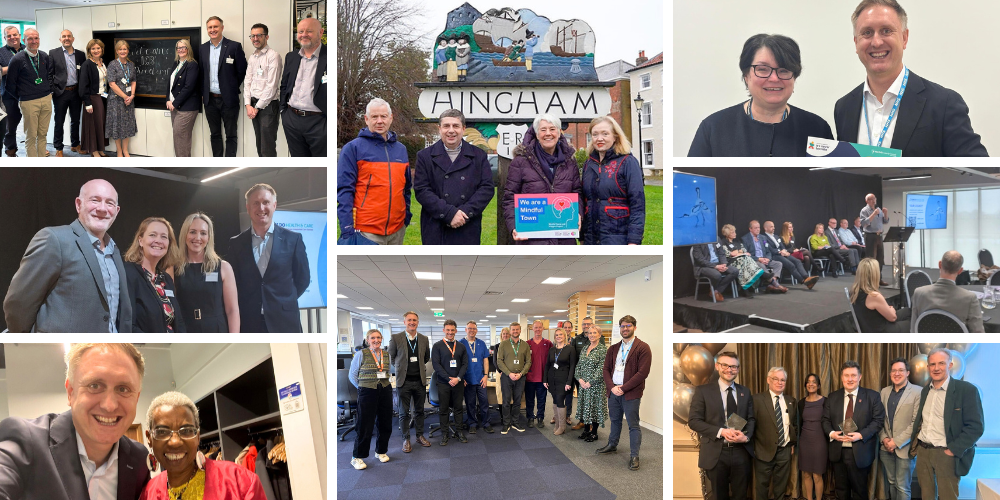
From top to bottom, left to right: ICB EMT at Breckland Council, Will Pope and Ed at the SNEE Legacy Event, Ed and Rachel Walton, CEO of African Families in the UK, Hingham Mindful Town, Ed at the UCCH, Ed and Suzanne Meredith, SNEE Legacy Learning Event, Dr Daniel James, Prof. Sir Sam Everington (President RCGP), Dr. Zohra Armitage, Dr Richard West MBE, Dr. Ben Spriggs, Dr Will Ridsdill Smith.
Celebrating Our People
Across the system, dedicated colleagues continue to make a remarkable difference.
Dr Enela Alimeta of Burlington Primary Care has received the RCGP Carole Brown Award 2026 for her innovative work in family planning, reproductive health and older women’s health. Her pioneering model for counselling and fitting long-acting reversible contraception has improved efficiency, freed up clinical time and achieved exceptionally high patient satisfaction.
Dr Richard West MBE and Dr Daniel James of Woolpit Health Centre have jointly received the RCGP East Anglia Faculty GP Prize 2026 for their Rural Minds project, which works with farmers, charities and clinical partners to raise awareness of mental health risks in agricultural communities through grassroots engagement and virtual-reality training.
I would also like to wish Suzanne Meredith, Director of Public Health for Norfolk, a happy retirement. Suzanne has been an outstanding system leader and I have always been impressed by her skilful, collaborative and calm approach. She has made a significant contribution to improving public health across Norfolk and will be greatly missed by colleagues and partners across the system.
Chris Strivens, Resuscitation Lead at Norfolk and Suffolk NHS Foundation Trust, is also celebrating an incredible milestone of 40 years in nursing. Since beginning his training at Hellesdon Hospital in 1986, Chris has supported patients across acute wards, community drug teams and forensic services, demonstrating remarkable dedication throughout his career.
Meanwhile, Mickey Cox, Heart Failure Specialist Nurse at James Paget University Hospital, has received a Special Recognition Award from national charity Pumping Marvellous. Through community outreach events in Great Yarmouth and Lowestoft, more than 500 free heart health checks were delivered, identifying several previously undiagnosed conditions and enabling earlier treatment.
Finally, the exhibition ‘Beyond Labels: Celebrating Disability in Suffolk‘ is currently on display at The Hold in Ipswich until 30 May. Developed with local groups, schools and individuals, the exhibition explores lived experiences of disability and includes the powerful community installation Unlabelled, featuring 150 giant decorated labels created by more than 30 local groups.
As we continue to shape the future of our health and care system, I want to thank colleagues across north east Essex for their continued hard work and collaborative spirit.
As our new Integrated Care Board structures go live on 1 April, that partnership and shared commitment will remain central to improving health and care for the communities we serve.
Best wishes,
Ed