9th December 2025
Hello and welcome to my December blog. As we approach the end of the year, I want to begin by acknowledging the significant organisational change we are navigating across both NHS Norfolk and Waveney and NHS Suffolk and North East Essex ICBs.
The national directive for ICBs to reduce spending presents a tough financial landscape for all of us, and I know many colleagues are feeling the impact—both professionally and personally. Despite this, the commitment, compassion and resilience shown across our teams has been remarkable. I also want to extend my sincere thanks to our partners, stakeholders and members of the public who have shown such kindness and support to ICB colleagues during this period of change. Your encouragement makes a real difference. To my ICB staff, thank you for everything you continue to do for our communities during what is an undeniably challenging time.
In each of my blogs, I share just some of the brilliant work happening across our system, framing these updates around the three key shifts of the NHS 10-Year Plan: bringing care closer to home, embracing digital innovation, and focusing on prevention. This month’s updates reflect that, even amid uncertainty, there is extraordinary work taking place to improve services, strengthen partnerships, and support people when they need it most.
From Hospital to Community
Across our patch, we continue to see services shifting closer to home, helping people live healthier, more independent lives.
I was delighted to join Sir Chris Whitty’s recent visit to Diss, hosted by South Norfolk District Council, to explore the challenges of rural health. Our discussions amongst the numerous partners there reinforced the importance of proactive, targeted and collaborative community-based care — ensuring people in isolated areas get the support they need closer to home.
In a similar way at the West Norfolk Place Board, I saw first-hand the strength of local relationships and the impact of their work as a designated Marmot Place. Partners across health, care, housing and community organisations are focusing on the wider determinants of health — tackling inequality at its roots and shaping a fairer future for local residents. We are now seeing this approach embedded in East Suffolk too, where a new Marmot Place has been launched bringing together East Suffolk Council, Suffolk County Council and both ICBs to improve access to services, education, employment and housing. The launch event, with contributions from Sir Michael Marmot and colleagues from across the system, provided a powerful reflection of how organisations are collaborating to address the deeper drivers of ill health and build healthier, more equitable communities.
There are excellent examples of innovation in primary and community care in West Norfolk. For example, a pioneering leg ulcer initiative—one of the first of its kind nationally—has been shortlisted for a Nursing Times Award. By embedding specialist wound expertise directly into primary care, the project has reduced waiting lists, improved healing outcomes, and empowered practice nurses with the skills and confidence to deliver high-quality care.
At The Queen Elizabeth Hospital, a new collaborative discharge programme is transforming patient flows. By working across partners—including NCH&C, Norfolk County Council, ECCH, Athena Care Homes and the ICB—community bed waits have reduced from up to 20 days to just five. Nearly half of patients using the reablement service are now regaining independence more quickly, and the number of people medically ready to leave hospital has fallen dramatically. This is the very best of integrated care in action.
I also enjoyed visiting North Norfolk District Council where I was taken to Cromer Hospital, including spending time with the outstanding Chief Nurse Rachel Cocker. Colleagues there advocated passionately for expanding services locally, reflecting the strong community identity and need for accessible care closer to home. There is a clear need to improve frailty services given the local population’s age profile.
And in general practice, work continues to strengthen resilience. The merger between Unity Healthcare and Glemsford Surgery in West Suffolk will give patients access to a wider clinical team and improved continuity. I want to thank everyone involved for supporting this positive transition for local residents.
Finally, it was inspiring to return twice this month to the University of East Anglia. I met Professor Sally Hardy to hear about the NICHE Anchor Institute programme—an impressive portfolio of over 70 integrated care initiatives making real improvements in rural and coastal communities. Discussions with the Vice-Chancellor, Professor David Maguire, also explored plans to expand dental training and access on campus, something I am very keen to see progress in Norfolk.
From Analogue to Digital
Digital innovation continues to play a vital role in making care more joined-up, personalised and efficient.
I’m pleased to share that the My Care Choices Register is launching this month across both our ICBs. Building on twelve years of success in North East Essex, this digital platform allows thousands more people—particularly those with frailty, dementia or at the end of life—to record their care preferences and ensure they are known and respected. This work will have a profound impact in improving symptom management, reducing unnecessary admissions, and supporting people to receive care in the place that feels right for them. This is a big-ticket initiative for the new ICB.
Neighbourhood plans in Great Yarmouth and Waveney are also accelerating, supported by Eclipse population health data. Local teams will focus on people at highest risk, particularly those with frailty and diabetes, with over £500,000 invested by the ICB to resource this work. I was delighted to meet with Sheila Oxtoby, CEO of Great Yarmouth Borough Council, who gave me a tour of The Place in Great Yarmouth, an impressive multi-service community hub with exciting potential to host even more integrated health services in the future.
Digital transformation is also supporting urgent and emergency care. The Unscheduled Care Coordination Hub (UCCH) in Norfolk and Waveney—bringing together EEAST, ECCH, NCH&C, IC24, the ICB and Norfolk County Council—has now supported 22,000 patients and avoided over 10,000 ambulance dispatches. It is no surprise the Hub is shortlisted again for a national HSJ Partnership Award.
More widely, digital access continues to evolve in general practice. Nationally, GP teams handled a record number of online requests in October, helping make access simpler and freeing up phone lines for those who need them most.
Finally, our joint innovation work with Health Innovation East and neighbouring ICBs through the Health Foundation’s Accelerating Innovation Systems programme has produced valuable insights into how systems can strengthen their cultures, capabilities and partnerships for long-term adoption of impactful innovation. This learning will directly inform our commissioning approach moving forward.
From Sickness to Prevention
Prevention remains a central priority for our system—and there is a great deal of inspiring work happening.
Norfolk County Council has launched a new Connect to Work programme supporting over 4,000 people with long-term health conditions or other challenges to prepare for, return to, or remain in employment. With economic inactivity rising, this is vital prevention in action—supporting people’s financial security, health and independence.
In Suffolk, the Keep Suffolk Smiling campaign has released a fantastic new video showcasing the importance of early toothbrushing, featuring pupils from Ranelagh Primary School. Alongside this, community toothbrushing programmes continue to strengthen oral health where inequalities are greatest.
Free lung screening events in Great Yarmouth and Gorleston, delivered in partnership with East Norfolk Medical Practice and the James Paget University Hospital, have helped people understand the importance of early detection. Since 2022, almost 18,000 local people have been invited—an incredible public health effort.
The government’s new HIV Action Plan will also see thousands of people supported back into care and treatment by 2030. Our ICB colleagues marked World AIDS Day by hosting a staff lunch-and-learn, and colleagues with lived experience shared powerful stories to help challenge stigma and encourage testing.
A new pilot in east Suffolk will identify up to 700 people with possible undiagnosed type 2 diabetes, enabling early intervention before complications develop. This work is essential to improving long-term health outcomes in our communities.
Prevention isn’t only about services — it’s also about the places we live, the air we breathe and the resilience of our communities. Both ICBs have now completed their refreshed Green Plans, going beyond national requirements to build a more sustainable health system and narrow inequalities. This is much more than carbon reduction; it’s about creating healthier environments, improving air quality, protecting nature and ensuring that today’s care doesn’t cost our communities tomorrow. We’re already seeing the benefits — cloud-based GP systems reducing travel and emissions, smarter digital tools unlocking hundreds of staff hours, and widespread NHS App use cutting paper and improving access. Prevention takes many forms, and our sustainability work is a vital part of supporting long-term health and wellbeing across Norfolk, Suffolk and North East Essex.
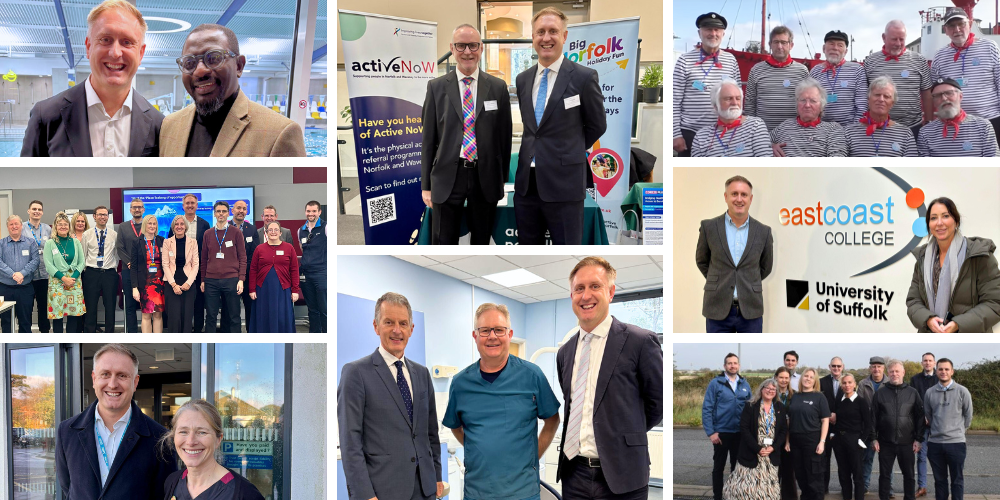
From top to bottom, left to right: Ed and Professor Aliko Ahmed, Regional Director of Public Health as part of Sir Chris Whitty’s visit to Diss, Ed with the West Norfolk Place Board, Ed at Cromer Hospital with Rachel Cocker Chief Nurse, Ed with Cllr Fran Wymark, Chair of Norfolk HWB, Ed with UEA VC Professor David Maguire and Dentist Simon Elphick at UEA Dental practice, The Motley Crew, Ed and Sheila Oxtoby at The Place in Great Yarmouth, Jaywick Sands Healthy Homes Team.
Celebrating Our People and Communities
This month has brought rich and varied reasons to celebrate the people who make our system exceptional.
It was great to attend the Norfolk and Waveney ICS Conference and share the stage with Cllr Fran Wymark, the host for the day. I particularly enjoyed speaking about the importance of people and communities over organisational structures.
I had the pleasure of meeting Dr Andy Wood OBE, chair of ECCH and Mid and South Essex Trust, whose leadership has shaped so much of my own thinking over the years. We are fortunate to have leaders of his calibre guiding health and care in our region.
Norfolk and Suffolk Music Hub has secured a second year of funding for its fantastic Young Ambassadors Programme, offering bespoke training and work experience to 70 young people with SEND.
In Jaywick Sands, the Healthy Homes Team—working with the ICB, Tendring District Council, Essex Fire and Rescue and others—has been shortlisted for a national award recognising their commitment to improving housing conditions and resident wellbeing.
And colleagues across Suffolk Community Foundation have helped more than 4,000 people access community-based mental health support through the Equity in Mind programme, strengthening local resilience at a time it is needed most.
Finally, I’m delighted that our vaccination teams have again achieved outstanding performance this winter. A special mention goes to ECCH, who have vaccinated 71% of their staff against flu, and to NNUH, currently the top-performing NHS Trust nationally — achievements that genuinely save lives. Alongside this success, we have once again teamed up with local sea shanty group The Motley Crew to encourage people to stay well this winter. Their new song, Get A Jab And Keep The Bugs Away, follows a hugely popular 2021 collaboration and highlights the importance of flu vaccination for those most at risk.
As we near the end of 2025, I am enormously proud of the compassion, determination and creativity I see every day. Despite the financial pressures and uncertainty ahead, the examples in this month’s blog show how deeply committed our teams are to improving health, supporting communities and doing so with kindness.
Thank you for everything you do.
Wishing you all a restful, peaceful December.
Ed