4th February 2026
As we continue through the winter months, I want to begin by recognising a truly mammoth collective effort across our health and care system. I’m delighted to share that more than one million COVID-19 and flu vaccinations have now been delivered across our area since the autumn campaign began — over 545,000 in Norfolk and Waveney and a further 500,000 across Suffolk and north east Essex. This extraordinary achievement has helped protect thousands of people and keep communities well. My sincere thanks go to everyone involved — from vaccinators and clinicians to volunteers and support teams — and of course, everyone who has come forward for their vaccination. With flu vaccinations available for eligible people until 31 March, it’s still not too late to get protected.
January also marked an important milestone as we held our first Board in Common meeting between our two Integrated Care Boards (ICB) at Endeavour House in Ipswich. This was a significant step as we work towards becoming the proposed NHS Norfolk and Suffolk ICB on 1 April. With our final Board in Common planned for the end of March in Norwich, I want to thank colleagues across both organisations — and our partners — for their hard work, professionalism and collaboration during this period of change.
There is so much good work happening across our system, and I’m really pleased to share just some of the highlights below — and how they reflect the three key shifts we are making together.

From Hospital to Community
Recent visits across Essex reinforced for me how powerful it can be to bring care closer to people, and into more appropriate settings. At Basildon Hospital, the Mental Health Emergency Department run by EPUT is offering people in crisis specialist, timely support in an environment designed around their needs, improving access and experience. It’s a model with real potential as we think about how similar approaches could be adapted across Norfolk and Suffolk.
In north east Essex, I was proud to visit Clacton Community Hospital and see progress on the new Urgent Treatment Centre — a £25 million development led by East Suffolk and North Essex NHS Foundation Trust — alongside the transformed Community Diagnostic Centre. Together, these changes mean more people can receive high-quality care closer to home.
During that visit, I also spent time at the Sunspot in Jaywick Sands with colleagues from Tendring District Council. This award-winning community and business hub, together with local efforts to improve housing, shows how health is shaped as much by people’s living conditions and opportunities as by the care they receive. As our ICB boundaries change in April, I want to take this moment to thank colleagues and partners across north east Essex. Over the past seven years, the commitment, collaboration and shared focus on improving outcomes for local people have been outstanding, and it has truly been a privilege to work alongside you in the local Alliance.
We’re also making progress in supporting older people living with frailty. At Norfolk and Norwich University Hospital (NNUH), the new Acute Frailty Hub is providing rapid assessment and early intervention, helping more people return home safely, avoid unnecessary admissions and maintain their independence and dignity.
Community-based mental health services are also making a real difference for older people and carers. Teams from Norfolk and Suffolk NHS Foundation Trust (NSFT), based at Carlton Court near Lowestoft, are supporting people living with dementia and their carers through practical initiatives that reduce isolation and strengthen community connections. Alongside carer and dementia cafés, the Great Yarmouth and Waveney In-Reach/Out-Reach Service is improving care planning, supporting smoother discharge and helping people return to their communities with the right support in place.
It was also good to see the first patients welcomed into the new maternity triage and assessment unit at James Paget University Hospital (JPUH), bringing services together in a purpose-built space to support faster assessment, improved safety and a calmer, more dignified experience for women and families.
Alongside this, the East of England Ambulance Service, led by CEO Neill Moloney, has continued to improve response times across the region despite sustained pressure. Category 1 and 2 response times improved year on year, call answer times reduced significantly, and performance strengthened across all ICB areas. While hospital handover delays remain challenging, we are working closely with acute partners, NHS 111 and clinical coordination hubs to reduce delays, improve “hear and treat” rates and ensure ambulances are available for those who need them most.
From Analogue to Digital
Our shift from analogue to digital continues to gather pace. Use of the NHS App has risen steadily across Norfolk, Suffolk and north east Essex, with monthly log-ins increasing by around 11.5% since April and repeat prescription requests growing by nearly 20%. With more than two million log-ins in December alone, digital tools are becoming part of everyday care — making it easier for people to manage their health while reducing pressure on frontline teams.
Digital innovation is also helping people access care in smarter ways. AHP Suffolk CIC has introduced the SelfBack app for people with uncomplicated low back pain, offering personalised digital support as an alternative to face-to-face physiotherapy. Early feedback shows significant improvements in pain, with very few patients needing follow-up, and the approach is now being extended into north east Essex through partnership working.
At JPUH, patients on the Concept Ward are benefiting from a new digital bedside service delivered with Airwave Healthcare and funded by the hospital charity. The technology improves comfort and connection, supports recovery and frees up staff time through features such as electronic meal ordering.
Meanwhile, at NNUH, robotic-assisted surgery capacity has doubled thanks to community-funded investment via the N&N Hospitals Charity. As NNUH marks ten years of robotic surgery in 2026, this milestone shows how digital innovation, clinical expertise and community support can come together to deliver world-class care close to home.
From Sickness to Prevention
Prevention continues to shape how we tackle inequalities and support long-term health. The King’s Lynn & West Norfolk Marmot Report provides a clear, evidence-based picture of the social factors affecting babies, children and families, reinforcing the importance of acting early to prevent poor health before it takes hold. It was equally powerful to listen to young people from across Suffolk through the 2025 Annual Public Health Report, shaped by youth-led events delivered with Volunteering Matters, reminding us how vital it is to place young people’s voices at the heart of decisions about health and wellbeing.
February 4 is World Cancer Day, which is an opportunity for me to encourage anyone who has been invited for an NHS lung health check to book their appointment. The Lung Cancer Screening programme is offered to current and former smokers aged 55–74. In Norfolk and Waveney, around 14,000 people have been screened, with 89 lung cancers detected so far — 65% at an early stage, when treatment is more effective. Lung cancer often has few symptoms early on, which is why these free, simple checks — many delivered in community settings — are so important. As part of the forthcoming National Cancer Plan, this programme will be scaled nationally by 2030, helping diagnose tens of thousands of cancers earlier and save more lives. If you receive an invitation, I’d strongly encourage you to take it up.
We’re also embedding prevention in how we grow our workforce and improve access. Pharmacy students from the University of Suffolk are gaining hands-on experience through placements with GM Graham Pharmacies, supporting earlier intervention while strengthening the future workforce. In oral health, targeted recruitment and investment are helping stabilise services in North and South Norfolk, while initiatives such as the SHINE programme in Ipswich — delivered by the Ipswich Town Foundation with University of Suffolk Dental CIC and supported by NHS Suffolk and North East Essex ICB — are helping children in higher-need areas build lifelong healthy habits. Alongside this, urgent dental care remains available across our counties, with 47 local providers supported by additional national providers to help deliver 700,000 extra urgent appointments.
I’m grateful to Jules Alderson for sharing our approach to volunteering in primary care at a national level, highlighting how volunteering can support prevention by improving access and helping people earlier and closer to home. Early support also extends to families, with mothers and babies at the Kingfisher Mother and Baby Unit at Hellesdon Hospital set to benefit from a new sensory playpark, funded by Norfolk County Council and NSFT, supporting recovery, bonding and wider family support.
I’d also warmly encourage everyone to take part in National HIV Testing Week (9–15 February 2026). Testing is quick, free and confidential, and is the only way to know your status — with free home tests available at freetesting.hiv or through GPs, clinics and charities. Finally, it was good to see households across Suffolk offered free access to a healthy meal-planning platform through Feel Good Suffolk and FiveDinners, supporting healthier eating while saving money and reducing food waste.
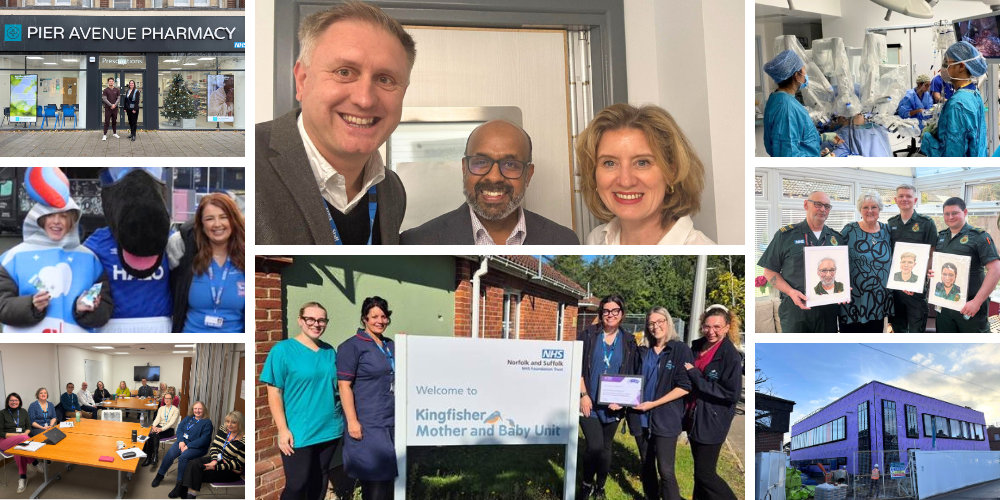
From top to bottom, left to right: Junchao Jiang and Dr Georgina Marsh outside G.M Graham Pharmacy in Clacton, SHINE Dental Promotion, ICB Seasonal School Session, Ed with Dr Maneesh Prasad, MD of Mental Health ED in Basildon and Dr Frankie Swords, Hellesdon Hospital’s Kingfisher Mother and Baby Unit, NNUH Robotic Assisted Minimally Invasive Oesophagctomy, EEAST Staff Portrait Presentation, The new UTC being built at Clacton Hospital
Celebrating Our People and Communities
Across our system, there is so much to be proud of. It was a real pleasure to join Nick Hulme at his retirement event, marking 46 years of outstanding public service. Nick rose to become one of the NHS’s most respected chief executives at East Suffolk and North Essex NHS Foundation Trust, and I was fortunate to work closely with him for 13 years. I learned a great deal from Nick, not least his unwavering commitment to tackling health inequalities. I wish him every happiness for the future and congratulate him once again on his recent investiture, receiving his CBE from Princess Anne at Windsor Castle.
It was lovely to hear that Professor Felicity Meyer, Deputy Medical Director and Consultant Vascular Surgeon at Queen Elizabeth Hospital (QEH) King’s Lynn, is featured in the national exhibition Insight: Portraits of Women in Surgery at the Hunterian Museum, celebrating the contribution of women surgeons across the UK while highlighting the inequalities that remain. QEH has also successfully revalidated its Defence Employer Recognition Scheme Gold Award for a further five years — the highest level of recognition — building on its Veteran Aware status and reinforcing the Trust’s strong commitment to supporting members of the Armed Forces community and their families.
It was great to see members of the agricultural community come together for the first Big Breckland Breakfast, organised by Breckland Council, offering farmers and their families a welcoming space to connect, share experiences and access support — an important step in tackling isolation in rural communities.
I was also really pleased to hear about A Roof Over Your Health, led by colleagues from JPUH and partners at Great Yarmouth Library, which brought health and wellbeing support directly to people experiencing homelessness. More than 35 people accessed practical advice and support, showing the impact of taking services to those who can find them hardest to reach.
I’d also like to recognise the fantastic work happening in West Norfolk to grow the next generation of health and care professionals. Colleagues from our West Place team and system workforce partners have developed a new Work Experience Co-ordinator role, hosted by the College of West Anglia and launching soon. Alongside this, significant investment at the College — supported by Norfolk County Council and the University of Suffolk — will benefit more than 1,300 health and social care students through new teaching spaces and clinical skills facilities. Together with the Health and Care Academy App, this work is helping local people explore careers, build skills and strengthen the future workforce.
Our ICB-led Seasonal Schools programme continues to go from strength to strength, bringing colleagues together to learn, connect and develop new skills. Recent workshops in King’s Lynn focused on system working and evidence-based practice and were delivered by Susannah Howard and Liesel Kennedy from the Suffolk and North East Essex Integrated Care Partnership, with further sessions on relationships, culture and leadership planned — reflecting our commitment to continuous learning and collaboration across the ICB.
Finally, it’s been heartening to see compassion and courage recognised in so many forms — from young people in Lakenheath in West Suffolk honoured for their bravery, to ambulance colleagues thanked through a former patient’s deeply personal tribute. Together, these stories reflect the very best of public service, and feel like a fitting note on which to end.
Thank you to everyone playing a part in this work — on the frontline, behind the scenes, and in our communities. Together, we are building services that are stronger, fairer and more responsive for the people we serve.
Best wishes,
Ed